On April 10, the 2026 Annual Working Conference of the Global Teacher Development Academy was held at Beijing Normal University. The meeting did not present itself through grand narratives, yet the institutional design it represents is quietly reshaping the trajectory of China’s educational opening-up. More than 70 participants attended, including representatives from the Teacher Affairs Department of the Ministry of Education, the China Teacher Development Foundation, and 22 branch institutions of the Global Teacher Development Academy. At the meeting, the Management Committee of the Academy was formally established. This move signals that the platform is moving beyond the “construction phase” into a stage of governance and institutionalized operation, with its organizational structure and operational logic rapidly maturing.
In the eyes of education observers, this system can be seen functionally as a post-Confucius Institute upgrade in China’s international educational cooperation. However, this “upgrade” is not a simple replacement, but rather a structural shift: from language and cultural dissemination as the core, to teacher capacity building as the core; from single-institution output, to cross-regional, multi-center, networked collaboration; and from cultural communication logic, to educational governance and professional cooperation logic. The emergence of the Global Teacher Development Academy is precisely an institutional response to this transformation.
The direct background for its establishment lies in the fact that China’s higher education internationalization has entered a more complex and demanding stage. Over the past two decades, China promoted language and cultural exchange through platforms such as the Confucius Institute, while also expanding openness through Sino-foreign cooperative education programs. However, with changes in the international environment and the acceleration of educational modernization, reliance on fragmented project-based, short-term exchanges and dispersed cooperation models has increasingly fallen short of the demands for high-quality development. In particular, teacher-related international exchange has long suffered from fragmentation, short-termism, and superficial engagement, lacking a systematic integrating platform. Against this backdrop, and under the coordinated leadership of the Ministry of Education, the Global Teacher Development Academy—jointly established by multiple universities and institutions and physically hosted at Beijing Normal University—came into being.
The Academy is led by the Ministry of Education and jointly built by 21 universities and institutions. Its core objective is to break the fragmentation of existing international teacher exchange programs, integrate international cooperation resources and teacher training systems across universities, and promote a shift from isolated activities to large-scale, system-based operations. In its institutional design, it has established a three-tier linkage mechanism consisting of “the Ministry of Education – the Academy – branch centers,” and clearly defined four core missions: attracting international teachers to China for training and study, promoting Chinese teachers’ overseas exchange, advancing targeted cooperation in key areas, and actively participating in global education governance. This structure positions it not as a single project platform, but as an emerging transnational educational governance network.
At the operational level, the Academy has further refined these four missions into ten key tasks, including the development of teacher education standards, pre-service teacher training, in-service teacher development, institutional collaboration abroad, digital resource co-construction, and collaborative teacher research. It has also introduced a “task-based commissioning system,” under which member institutions undertake projects based on specific countries and regional responsibilities. This mechanism strengthens task orientation and coordination efficiency, enabling universities to leverage their comparative advantages within a unified framework while avoiding duplication and fragmentation of resources.
In terms of development, the Global Teacher Development Academy has already built a preliminary global network system. Several regionally specialized branches have been established. For example, the Southeast Asia Academy hosted by Hainan Normal University focuses on teacher training and educational cooperation with ASEAN countries; the Latin America Academy at Shanghai Normal University focuses on teacher development and educational exchange in Latin America; the Central Asia Academy at Xinjiang Normal University serves as an important node for educational cooperation with Central Asian countries under the Belt and Road Initiative; and the Wutong Academy (Global International Chinese Teacher Development Academy) at Beijing Language and Culture University focuses on training and capacity building for international Chinese language teachers.
These regional academies give the system a distinct “regionalized + specialized” character rather than a uniform replication model. For instance, the Central Asia Academy places stronger emphasis on adapting to local linguistic and educational systems, while Southeast Asia and Latin America projects are more closely aligned with basic education reform and vocational education needs. This differentiated layout makes the system resemble a global co-construction network for educational capacity rather than a one-way output platform.
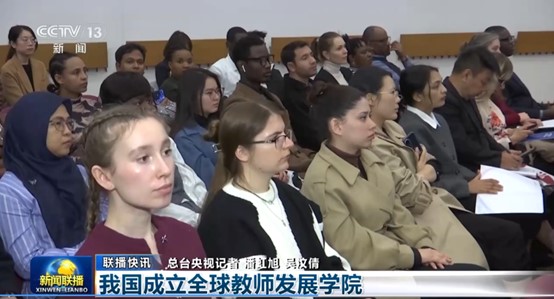
In practice, the Academy has already launched a series of significant international activities. On March 27, 2025, the first international teacher training program was held at Beijing Normal University, bringing together around 200 teachers and students from more than 50 countries, marking the formal launch of the platform’s operational phase. In the first half of 2025, member institutions organized 650 overseas exchanges for Chinese teachers across more than 30 countries and regions; hosted 1,500 foreign teachers for training in China; and conducted training programs for over 1,000 STEM teachers. In addition, 38 branded international teacher training programs were selected, of which 10 were designated as flagship projects, indicating a shift from scale expansion toward quality filtering.
Strategically, the Academy is expected to focus on neighboring countries, Belt and Road partner countries, Africa, and the broader Global South, developing tailored teacher exchange programs and encouraging leading universities to establish overseas teacher training bases to support local education system development and reform. This direction positions the platform not only as a tool for China’s educational internationalization, but also as an emerging participant in global education governance.
However, the system still faces significant challenges. First, institutional coordination remains difficult, as differences in teacher qualification systems, curriculum standards, and governance structures across countries increase the cost of cross-border alignment. Second, resource imbalance across the multi-center network may lead to uneven development and capacity gaps. Third, uncertainty in the international environment means educational cooperation in some regions may still be interpreted through geopolitical lenses. Finally, building sustainable long-term teacher mobility—rather than short-term training or visits—remains a key challenge for institutional implementation.
If the Confucius Institute represents the early phase of China’s educational “going global” strategy centered on language and cultural exchange, then the Global Teacher Development Academy emphasizes teacher-centered capacity building and institutional cooperation. This shift represents not only a technical upgrade, but also a transformation in China’s role within the global education system—from a participant to a more structurally influential provider of institutional frameworks. Whether it can ultimately evolve into a form of global educational infrastructure will depend on its long-term ability to ensure institutional stability, professional depth, and international trust.