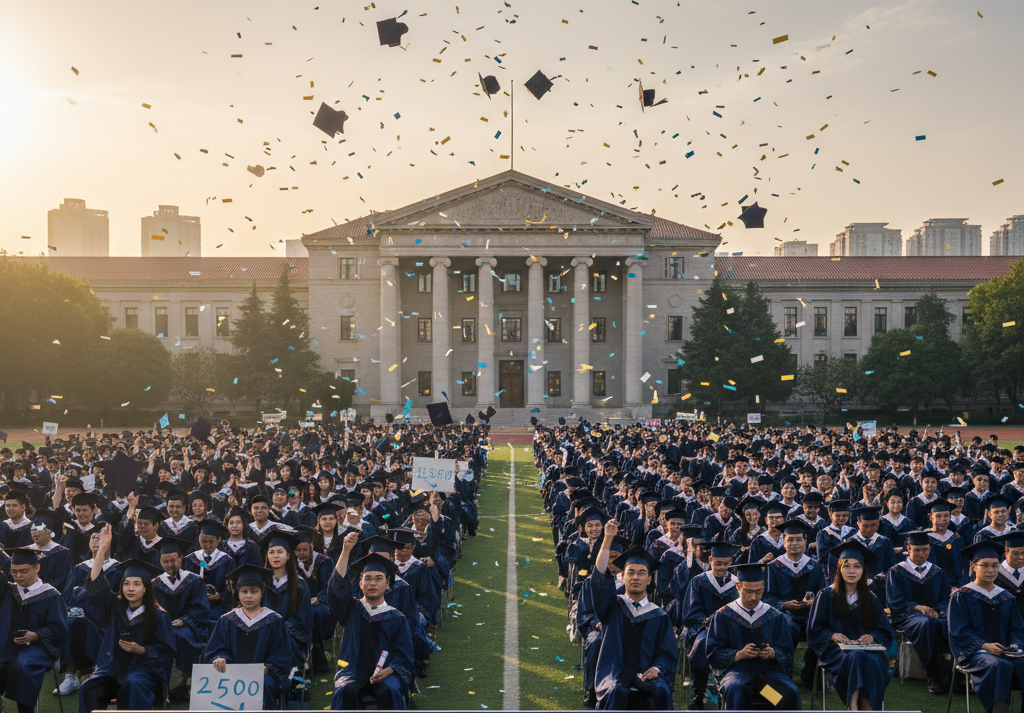
In 2026, the scale of China’s college graduates has once again shattered historical records. According to recently released data from the Ministry of Education, the number of graduates from national universities is expected to reach 12.7 million in the Class of 2026. This represents an increase of approximately 480,000 (about 4%) compared to the 12.22 million in 2025, making it the largest graduating cohort in the history of Chinese higher education.
This figure signifies not only an unprecedented influx of job seekers into the market but also a new phase in the expansion of China’s higher education system. Media reports indicate that since 2022, the number of graduates has exceeded 10 million for several consecutive years:
- 2022: 10.76 million
- 2023: 11.58 million
- 2024: 11.79 million
- 2025: 12.22 million
- 2026: 12.70 million
While this rapid expansion has allowed more young people to obtain degrees and transformed China’s labor structure, it has also placed immense pressure on the job market. Scholars estimate that 12.7 million graduates are equivalent to the population of a medium-sized city; adding such a massive demand for employment annually poses a severe test for both the economic structure and the labor market.
Meanwhile, job growth has not kept pace. Recruitment scales in some industries have declined, and companies are becoming more cautious, highlighting the contradiction between graduate supply and available positions. Amid economic restructuring and industrial upgrading, traditional roles are vanishing while emerging industries demand higher technical skills—a structural shift that complicates the employment landscape.
In response, the government and universities are intensifying employment services. The Ministry of Education has launched the “2026 Graduate Employment Expansion and Quality Improvement Action,” aiming to boost employment rates by expanding recruitment channels, strengthening career guidance, and encouraging entrepreneurship.
Rising Employment Pressure and Prolonged Job Search Cycles
As the graduate population expands, employment pressure on Chinese youth is mounting. Research suggests that the dual impact of increasing graduates and slowing economic growth has intensified competition. In 2025, the youth unemployment rate remained high, with some data showing the rate for the 16-24 age group once exceeding 17%.
This pressure has significantly prolonged the job-seeking cycle. Unlike in the past, when many secured jobs before graduation, many students now spend months or longer searching afterward. University career departments report that “slow employment” and “delayed employment” are becoming increasingly common, as graduates choose to prepare for postgraduate entrance exams, civil service exams, or professional certifications to defer their entry into the labor market.
The supply-demand imbalance is stark. Data shows that in 2025, there were approximately 5.67 million valid campus recruitment positions for over 12 million graduates—a ratio of nearly 2:1, meaning two graduates compete for every single opening. In popular sectors and large enterprises, competition is even more cutthroat, with some central or tech giants receiving hundreds or thousands of resumes per position.
Furthermore, a mismatch between academic majors and industrial needs exacerbates the situation. Traditional liberal arts majors face limited job growth, while fields like AI, the digital economy, and new energy—despite growing demand—prefer candidates with technical skills or practical experience.
Declining Salary Expectations: Starting Salaries Below 3,000 RMB
As competition intensifies, starting salaries have seen a noticeable shift. In some cities and industries, starting monthly pay has dropped to around 3,000 RMB, occasionally falling below the income levels of some blue-collar roles.
This is particularly evident in liberal arts and entry-level positions. Many graduates find that the “high salaries” advertised on recruitment platforms are often lower in reality due to companies using probation periods or performance-based pay to suppress base salaries.
This decline is tied to market dynamics: with an oversupply of graduates and limited hiring, employer bargaining power has increased. Many graduates now accept lower pay or temporary roles just to gain experience. However, the cost of living—especially rent in Tier-1 cities like Beijing, Shanghai, and Guangzhou—makes financial independence difficult, forcing many to rely on family support or side gigs.
Consequently, mindsets are changing. The focus has shifted from “chasing high salaries” to “securing a job first, developing later.” More graduates are now looking toward smaller cities or exploring diverse paths like flexible employment and entrepreneurship.
Structural Contradictions and Market Transformation
Experts argue that the issue is primarily one of structural contradiction rather than a simple lack of jobs. While traditional sectors are shrinking, emerging tech industries face talent shortages. Graduates with backgrounds in programming, data analysis, or engineering remain highly competitive.
Regional disparities also persist. Most graduates prefer Tier-1 cities, while central and western regions or grassroots positions struggle with talent shortages. To alleviate these pressures, the Chinese government continues to roll out stability-focused policies. The 2026 Government Work Report listed employment as a top macroeconomic goal, aiming to create over 12 million new urban jobs through tax incentives, subsidies, and startup support.
Ultimately, the 2026 employment landscape remains complex. The challenge lies in balancing the record-breaking scale of graduates with high-quality job creation and ensuring that the education system evolves to meet the needs of a modern industrial economy.